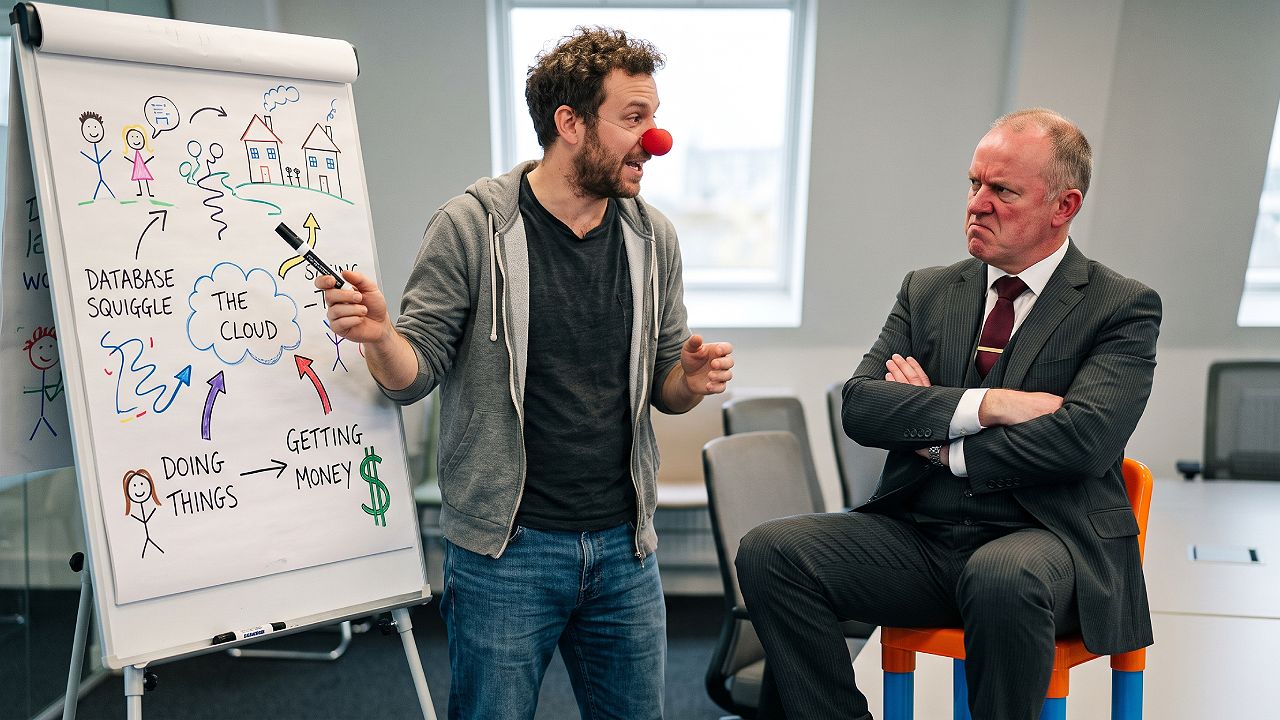
AI did not invent the fight between product and engineering. It removed the waiting time that used to hide it - and made the bill for two C-level scoreboards arrive faster.
This is for CEOs, boards, and operators who still run a digital product with two C-level scoreboards: a Chief Product Officer for the bet, a Chief Technology Officer for the system.
The popular story says anyone can build software now, so the org chart can stay as it is - or get thinner, because “the tools will align the teams.” That story costs money. It also costs months.
AI gives product people just enough engineering power to ship a convincing demo. It gives engineers just enough business insight to question the roadmap in the same afternoon. The handoff that used to take a quarter now takes a week. Two executives who only meet in the escalation still behave as if the old calendar is real.
That lag is the bill.
The two-clock problem
Imagine a factory where one shift can now cut a prototype part in a day, and the other shift can now see the order book in the same tool. You do not keep two plant managers who only reconcile on Fridays. You get scrap, or you get a warehouse full of the wrong parts, faster than before.
In software terms: a product manager can spin up a rough MVP without waiting for a full engineering team. An engineer can generate more code, with more context about the customer, than last year’s process assumed. The old sequence - write the ticket, throw it over, argue in sprint review - is too slow for the new machines.
The work on the floor is already mixed. Product engineers sit in the gap on purpose. They connect a customer problem to working software.
The C-suite often is not mixed. One leader still says “build the thing.” The other still says “first, nine months on the platform.” The team is left asking who decides.
That question used to be annoying. Now it is expensive. Speed without a single owner does not create alignment. It creates two fast, contradictory plans.
What actually changed
Code is no longer the scarce resource in every situation. Judgment is.
Product now has engineering power. Not production engineering. Demo power. Enough to test whether an idea deserves real money. Enough, if nobody stops it, to put a prototype where paying customers can trip over it.
Engineering now has business insight. Not a second MBA. Enough context that “can we implement this?” is the wrong first question. The better list is: should we, for whom, what outcome, what is the cheapest reliable test, and what will it cost to keep.
A working demo is not a production system. “Anyone can build software now” still contains a generous amount of marketing. Security, architecture, reliability, data quality, and the on-call roster did not get automated away. They got more important, because bad software can now be generated at scale.
So the split did not get cleaner. The boundary got wet.
Who owns an AI feature that faces the customer, sits on the model stack, burns inference cost, and can be wrong in a way that kills trust? Product, because of the interface? Engineering, because of the system? Neither answer is sufficient. Somebody has to own the intersection.
If that somebody is the CEO, you turned the chief executive into overflow again.
What the uncombined C-roles cost
Keeping a separate CTO and CPO is not free. It never was. AI raised the interest rate.
Time: every mixed decision now needs a summit. Prototype in week 1, architecture veto in week 3, rewritten bet in week 5. Competitors who decide in one head, or in one room with one owner, are already live.
Money: you pay two executive seats to negotiate what a single trade-off owner would have killed or scoped on Tuesday. You also pay the rework. The demo that leaked into production. The platform rewrite that started because product could not be told “no” with numbers. The feature that shipped because engineering could not be told “not this customer, not this quarter.”
Talent: product engineers will not stay in a company where two bosses can overrule each other. They will go where the outcome has a name.
This is not an argument that two salaries are one salary too many. Headcount theater is how you hire a bottleneck and call it synergy. The waste is the latency between “what” and “how” when those two words no longer live on different calendars.
When you still split - and how you do not lie about it
Yes. And no. And yes.
Keep two C-roles when technology is mostly internal support, when product and technology are different businesses, or when the company is large enough that each craft needs a specialist and the operating model already resolves trade-offs in days, not quarters.
If you keep the split in a digital product company, you still need overlap literacy. The CPO has to reason about feasibility, cost to run, and failure modes. The CTO has to reason about the customer, the bet, and what “done” is worth. A handshake after the fact is not a model. It is a hope.
Combine them when you sell software or digital services, the roadmap already stalls, technology moves revenue, and AI is how the team now discovers and delivers. Then the CPTO versus CTO versus CPO question is no longer theoretical. Two scoreboards, or one owner.
The downside of the combined seat does not vanish because the tools got faster. The person will lean toward the craft they trust. Without strong deputies, you created a single point of failure that can now ship mistakes at AI speed.
The definition of the combined job is at the-cpto.com/what-is-a-cpto.
Things to ask this quarter
- Who owns a customer-facing AI capability that is also a systems and cost problem?
- How many days does a mixed product-engineering decision wait for a C-level handshake?
- What leaked from demo to production in the last 2 quarters, and who had the right to stop it?
- If we keep two C-seats, where is the written rule for who loses when value and reliability collide?
- Are we paying for two strategies, or for one trade-off?
If you cannot answer the last one, you are already paying the AI tax. You are just not putting it on the agenda.
The bottom line
AI gave product a workshop and engineering a window into the order book. The floor already works as one system. Two C-level clocks on that floor cost time and money.
Do not merge the titles to look current. Do not keep them split because 2019 felt orderly. Decide who owns the intersection before the next demo becomes next quarter’s incident.
Remember: one bottleneck moved up. Ownership has to follow.