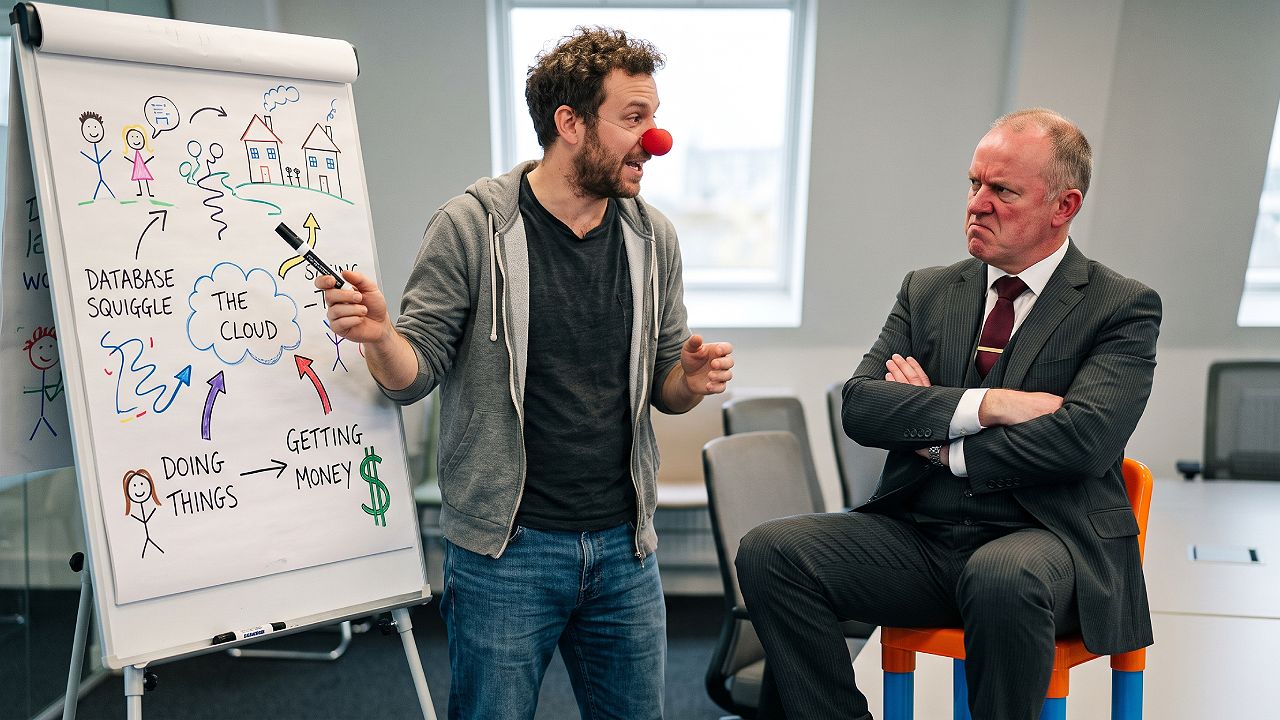
The board does not owe you a standing ovation for your architecture.
This is for CTOs, CPTOs, and technical executives who have to get a real decision out of a room that owns capital, not code. It is not a slide-design tutorial.
The popular story says you win the board by teaching them technology. You do not. You win by sitting in the shareholder seat long enough to translate technical reality into money, time, risk, and option value - then putting a choice on the table they can own.
If they cannot own it, you did not educate them. You briefed them.
The shareholder test
Imagine you are not the CTO. You bought a slice of this company. You want the share to be worth more in 3 years, not a prettier repo in 3 weeks.
From that chair, almost every technology update collapses into four questions:
- Does this protect or grow the value of the asset?
- What can kill that value faster than we can react?
- Are we spending like owners, or like a department defending a budget?
- If this goes wrong, who is accountable - and did they say so before the vote?
Mind that technical truth still matters. You just do not get to dump it untranslated. “We need to refactor the platform” is a shop-floor sentence. “If we keep the current system, the next revenue initiative slips 2 quarters and a key-person departure becomes a 12-month rewrite” is a shareholder sentence.
Same reality. Different job.
Funny thing: the board already thinks in alternatives. They do it for pricing, hiring, and M&A. Technology is the one place they are often handed a single sermon and asked to bless it.
That is how you lose.
What “educate” actually means
Education is not a glossary. It is not a tour of the stack. It is not a 40-slide appendix that proves you worked hard.
Education is this: the room can repeat the decision, the downside, and the alternative without you in the chair.
To be honest, most technical leaders fail here because they want to be understood as experts. The board does not need another expert. They need a fiduciary who still knows which technical facts are load-bearing.
Put the implementation in an appendix. Keep the room on the trade-off.
Do not say: coverage is at 40%, the monolith is tightly coupled, we should move to services.
Say: outage risk is rising on the billing path, a 6-week investment cuts the chance of a revenue-stopping incident, and if we skip it we are betting the next two enterprise deals on a system we already do not trust.
If you cannot make that translation, you are not ready for the meeting. Do the work first.
How you win
You win before the meeting. A surprise in the board pack is treated as an ambush, even when the news is true.
You win with a recommendation, not a tour. One sentence at the top: what you would do with their money, and what breaks if they do the opposite.
You win by bringing alternatives every time. A single option is lobbying. Three options is governance.
Use this shape:
- Recommended. The path you would take with your own shares. Cost, time, what it unlocks, what it still does not fix.
- Cheaper / slower. What you can do with less money or less interruption - and the extra risk you are buying.
- Do nothing / delay. The honest baseline. Not “we keep dreaming.” The bill 12 months later: slower delivery, a security hole, a rewrite, a missed window.
Then you write the override in plain language.
If the room picks option 3 against your advice, you do not sulk and you do not sabotage. You record it. “The board chose to delay platform investment to protect this year’s feature plan. I recommend against this. Residual risk sits with this decision: a key-person rewrite risk, a 2-quarter slip on initiative X, and no new security control on system Y.”
That sentence is not theater. It is how grown-ups transfer responsibility. You still execute the chosen path as well as it can be executed. You do not pretend you recommended it.
Pro tip: pre-wire the CEO and the director who will actually fight you. The meeting should confirm a decision, not discover one.
A one-page plan they can fund
Walk in with a plan that would survive a controller.
Decision: what we are choosing, in one line.
Why now: the commercial or risk trigger, dated. Not a vibe.
Options: the three paths above, each with cost, calendar, and what we give up.
Ask: capacity and cash, not a slogan. “20-30% of engineering time for 2 quarters” plus the loaded cost in currency.
Proof: 3 numbers a non-engineer can read without you. Delivery time for a named initiative. Incident hours on a named system. Share of engineering time spent on rework versus new value. Use your baseline. Do not import a trillion-dollar industry horror story and hope it applies.
First review: a date. If the numbers have not moved, you come back with a changed plan, not a longer explanation.
Kill criteria: what would make you stop or split the work. Boards trust people who can end their own projects.
If you cannot fill that page, you are asking them to fund a feeling.
Things to put on their shoulders
- If they fund a demo as if it were a product, say so. A working prototype is not a production system.
- If they cut maintenance to hit a launch date, name the date the interest comes due.
- If they want AI on the roadmap and refuse the data, security, and operating cost, put the contradiction in the minutes.
- If they hire for a title instead of a trade-off owner, point at the CPTO versus CTO versus CPO problem: two scoreboards, or one owner.
You can be loyal and still be blunt. Loyalty without a written alternative is just fear with a badge.
The role definition behind that translation job is at the-cpto.com/what-is-a-cpto.
The bottom line
Speak like a shareholder. Keep the technical reality. Put the choice, the cheaper path, and the “do nothing” bill on one page. If they override you, they own the residual risk - in writing.
Remember: translate, recommend, record.